The Story
Leeds, a microscope, and everything after
Training
A deliberately narrow path
He qualified from the University of Leeds in 2009, then took the long route through ophthalmic specialist training to Fellowship of the Royal College of Ophthalmologists and a Certificate of Completion of Training.
Ophthalmology is unusual among surgical specialties in how early it forces a choice. The eye is small enough that genuine mastery of one region tends to come at the cost of breadth, and most consultants settle into a single subspecialty for the rest of their careers.
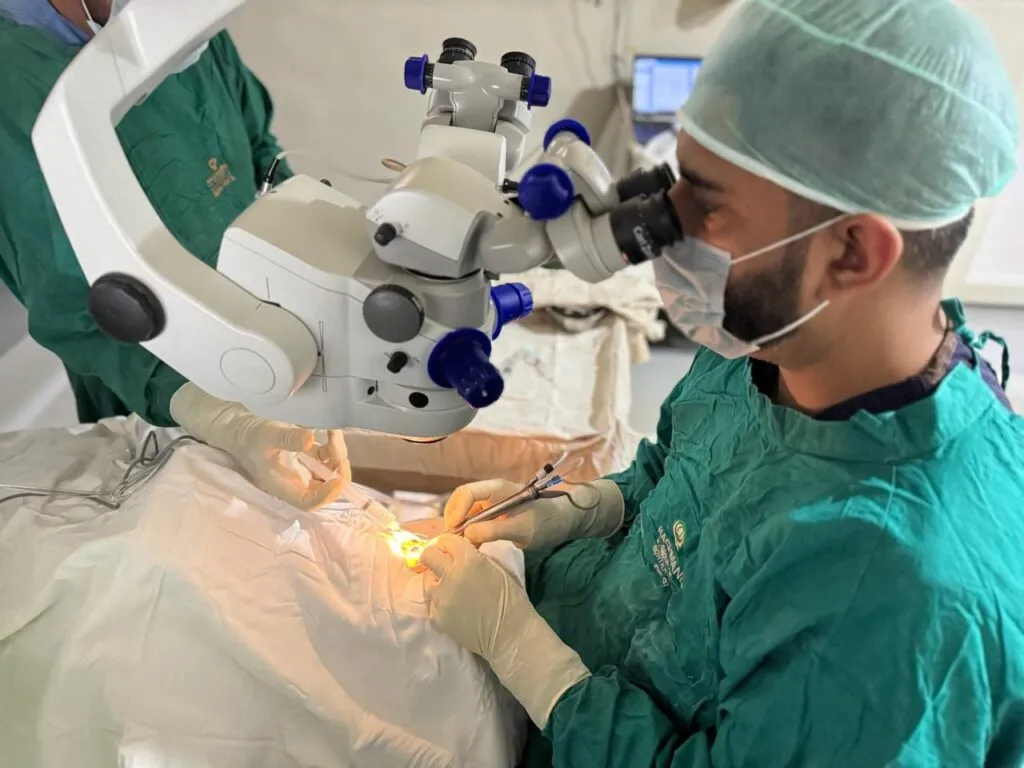
He completed two. The first, in paediatric ophthalmology and strabismus, deals with the six extraocular muscles that aim the eye — in patients frequently too young to describe what they can see. The second, in oculoplastic surgery, concerns the eyelids, the orbit and the tear drainage system: the architecture around the eye rather than the eye itself.
Held together, the two produce a surgeon comfortable with both millimetric alignment and facial proportion. It is an uncommon pairing, and it accounts for most of the shape of his practice today.
Where He Works
Rooted in Yorkshire, not confined to it
Substantive Consultant Ophthalmic Surgeon
Calderdale and Huddersfield NHS Foundation Trust
since 2020
College Tutor, Royal College of Ophthalmologists
Calderdale and Huddersfield NHS Foundation Trust
training the next intake of ophthalmic surgeons
Consultant, private practice
Spire Elland Hospital
Elland, Halifax
Partner
Newmedica
Bradford and Huddersfield
The base is West Yorkshire and it stays that way. The consulting rooms are in Elland, Huddersfield and Bradford rather than a London postcode, and the NHS post is substantive rather than nominal — he still runs lists, still teaches trainees, and still takes the complicated cases nobody else wants.
The practice, though, travels. Where a client's schedule or circumstances make a Yorkshire clinic impractical, arrangements are made around them — working alongside locally licensed teams in accredited hospitals in the country concerned. It is the same model that governs the charity work, and it exists for the same reason: the surgeon should be the thing that moves, not the patient.
A good result in eyelid surgery is one that nobody can identify as surgery.
Qualifications
On paper
- MBChB, University of Leeds (2009)
- BSc (Hons)
- MSc
- FRCOphth — Fellow of the Royal College of Ophthalmologists
- CCT in Ophthalmology
- Fellowship in Paediatric Ophthalmology
- Fellowship in Oculoplastic Surgery
Registered with the General Medical Council under reference 7039600, verifiable independently at any time.
Memberships & Recognition
Elsewhere
- Fellow of the Royal College of Ophthalmologists
- British and Irish Paediatric Ophthalmology and Strabismus Association
- Bupa Fee-Assured
- AXA Health recognised
- Top Doctors UK — Recognised Specialist
He also contributes to audit and quality improvement work on cataract surgical outcomes and paediatric orthoptic services.
Beyond the Theatre
The man, not merely the surgeon
Away from the clinic he is a committed golfer, a serious student of cinema who writes about it publicly, an advisor to a charity funding sight-restoring surgery overseas, and a medical reviewer for public-facing health publishing.
None of it is incidental to the work. Golf enforces the patience that theatre demands. Cinema trains the same visual attention that surgery consumes. The charity work is a standing reminder of what the specialty is ultimately for. And the reviewing is the same instinct that makes him a College Tutor — a low tolerance for bad information reaching people who cannot easily check it.
The Clinical Practice
Looking for an appointment, not an anecdote?
Consultations, treatment information, pricing and referrals are handled entirely through the practice site, with clinics at Spire Elland Hospital and Newmedica in Bradford and Huddersfield.